The platform everyone depended on, and nobody could touch
An Icelandic telco and media group had accumulated three overlapping warehouses, roughly 1,200 stored procedures holding business logic, half a dozen ETL tools and three BI platforms. Each was justified when it arrived; none was ever retired.
It produced the reports it had to. It also produced 188 incidents a year, and conflicting numbers depending on which warehouse you asked. The data specialists spent their time on reconciliation, fixes and incident response, while the analysis the business actually wanted kept being deferred.
The programme turned on a single reversal: free the people from fixing data, and let them work with it. A Databricks lakehouse gave the foundation. What makes it different is what went in from the first day.
First, one version of everything
Solid foundations come before any AI. Every business source — advertising sales, billing and usage, CRM, the national registry, ERP and planning — now lands in one governed lakehouse with full lineage in Unity Catalog.
Nine business areas keep curated gold workspaces, modelled together with the business owners, alongside certified semantic models where each KPI is defined once — conformed dimensions, row-level security and Git versioning.
That last part carries more weight than it looks. Everything that consumes the platform — a dashboard, an analyst or an AI system — reads the same certified figures, and sees only what it is allowed to see.
AI-native, not AI-added
Most implementations bolt a chatbot on at the end. This platform was designed with AI inside it, all of it running on Claude models, working both as the operator of the platform and as the interface to the business. Through the Databricks MCP and the Power BI MCP, Claude gets direct, governed access to the lakehouse and the certified semantic models — the data, the KPI definitions and the permission structure together.
The platform runs itself
Self-healing, humans in the loop
Agents watch the pipelines, the data-quality checks and the incident queue, and act on what they find — with human approval required before anything merges.
Engineering, guardrailed
Idea to production, faster and safer
AI writes a substantial share of the platform code inside safety guardrails. Custom skills encode the client's own standards, so AI-assisted changes follow the disciplined path rather than around it.
The business asks directly
Plain language, certified answers
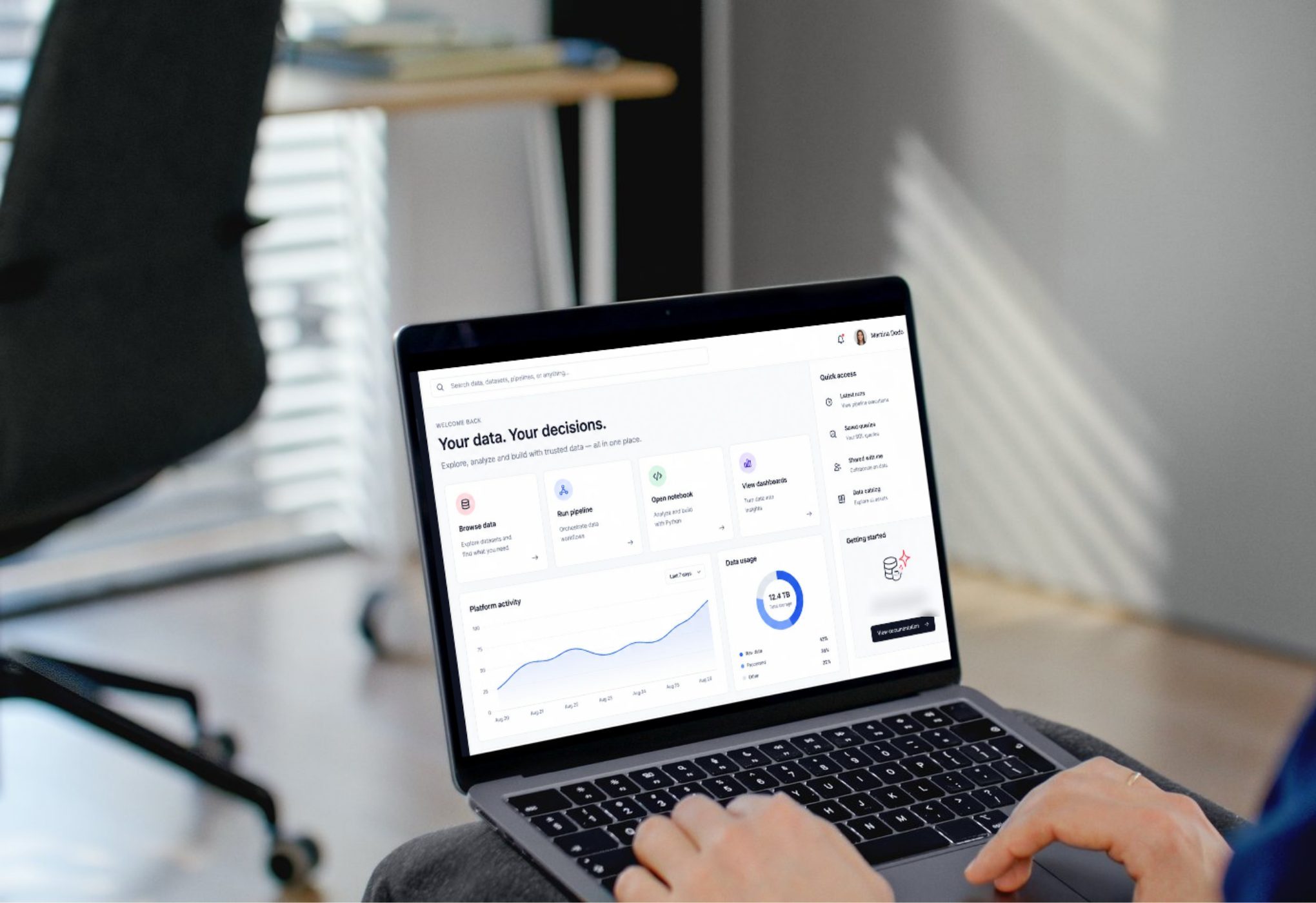
Nobody needs to understand the semantic layer. People describe the work they are doing and ask where the data helps; Claude, holding the full business context through the MCPs, answers.
Beyond analysis
A base for AI automation
Turning governed surfaces into tools via MCP makes automation a property of the platform rather than a series of separate projects.
Security by design
The data stays home
Everything runs inside the client's secured environment, AI included. The models work where the data already lives.
Half the run-rate, and the team back on analysis
Consolidating the tools into one governed platform ends the arguments about whose number is right. The people who used to keep pipelines alive now sit with the business teams, contributing to the platform directly rather than adding to a backlog.
Folding legacy licences, parallel pilots and ageing infrastructure onto the lakehouse roughly halves the platform's run-rate — while adding the scalability, governance and AI capability that were not available before. Support through the Databricks partnership part-funded the programme, which lowered the up-front investment before the savings began.
What the platform made possible next
A governed lakehouse with certified models is not the end of the programme — it is the thing everything else stands on. The first build on top of it was master data: a governed write-back loop driven from chat, human-confirmed and fully audited, for about €40 a month in net-new cost.
Team
- —Filip Strunjak
- —Ihor Protsiv
Key objectives
Replace three overlapping warehouses, six ETL toolchains and three BI platforms with one governed lakehouse.
Free the data specialists from reconciliation and incident response, and put them back on analysis.
Build AI in from the start — running the platform, guarding the engineering, and answering the business directly.
Services
- —Data platform architecture
- —Data engineering
- —Semantic modelling & BI
- —AI & MCP integration
Technology
Numbers
~50%
Lower platform run-rate after consolidation
9
Business-area gold workspaces, owned by the business
6→1
ETL toolchains consolidated into one lakehouse
188
Incidents a year on the estate it replaced
~1,200
Stored procedures holding business logic
2–3
People freed from firefighting per phase